Toughened glass splashbacks: what the toughening actually does
A splashback behind a hob is the one piece of glass in a house that gets heated unevenly every single day. This is the technical case for toughened glass splashbacks, and the specification to insist on in writing.
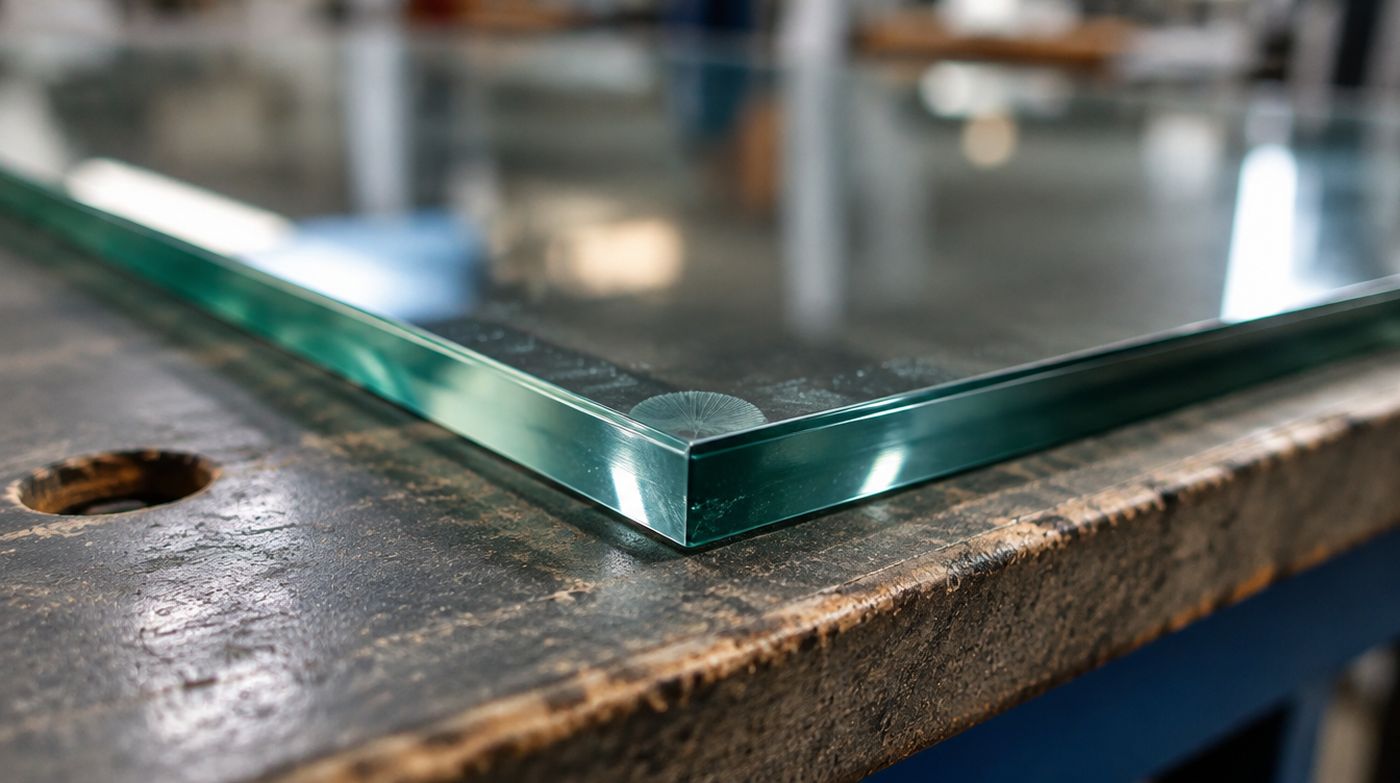
Why toughened glass splashbacks are not an upgrade but a baseline
Heat a patch of glass and it tries to expand. The glass 200mm away, still cool, holds it back. That restraint puts the boundary between hot and cool into tension, and glass is strong in compression and weak in tension. Annealed glass, the ordinary stuff in a picture frame, has very little tensile strength, so a tiny flaw at a cut edge is enough for a crack to start and run. Behind a hob that is not a remote possibility, it is a matter of time.
Toughening answers it directly. The process leaves the outer surfaces of the pane in permanent compression, so any tension you apply has to cancel that compression before it can begin to open a flaw. The result is a pane that shrugs off the daily thermal cycle of a gas ring, a wok burner or a pan lifted off the hob and set down against the wall.
The standard to ask for by name is BS EN 12150, which covers thermally toughened soda lime silicate safety glass, with break characteristics meeting BS 6206 Class A. Strictly, the Building Regulations requirement for safety glass in Approved Document K is aimed at doors, side panels and low level glazing rather than a splashback, and we would rather be accurate about that than pretend a regulation says something it does not. The failure mode behind a hob is reason enough on its own.
The second reason is what happens when glass does break. Annealed glass produces long curved shards at the height of a worktop, next to a cook holding a pan. Toughened glass dices into small blunt fragments. Nobody wants either event, but only one of them belongs in a kitchen.
What happens to the glass in the toughening furnace
The cut and finished pane is carried on rollers through a furnace at around 620°C, which is above the point at which the glass starts to soften, then driven out into a quench where high pressure air hits both faces at once. The surfaces cool and set first. The core cools afterwards and contracts, pulling those already rigid surfaces into compression and leaving the middle of the pane in tension. That locked-in balance is the toughening, and it gives several times the bending strength of the same pane untoughened.
Two consequences follow and neither can be worked around. The first is that a toughened pane cannot be cut, drilled, notched or edge-worked afterwards. Every socket cut-out, every radius, every polished edge has to exist before the pane enters the furnace. The second is that the pane is now a single stressed unit. If it fails, it fails completely and dices. There is no repairing a chip and no shaving 3mm off a long edge on a fitting day.
There is one honest cosmetic point about horizontally toughened glass. Contact with the rollers leaves a very slight ripple, known as roller wave, which you can sometimes pick up in a reflection on a long gloss panel if you look along it at a shallow angle. A good processor controls the furnace and orients the pane so the wave runs the least obtrusive way, and on a back-painted splashback it is rarely noticeable. Anyone claiming it does not exist at all is selling rather than explaining.
Thermal shock, edges and the real failure mode
Because the strength of toughened glass lives in its surfaces and edges, damage to an edge is what matters. A chip from a corner knocked on a concrete floor, a scuffed arris, a cut-out with a square internal corner instead of a radius: these are the points where stress concentrates and where a pane that has been fine for a year suddenly is not. Edges on a splashback should be arrissed or flat polished, and internal corners on cut-outs should always be radiused.
Clearances are governed by your hob, not by us. Gas and solid plate hobs have a stated minimum distance from the burner or pan support to an adjacent vertical surface in the manufacturer’s instructions, and that figure varies by model, which is why we ask for the make and model before anything is templated rather than quoting a number of our own. Range cookers behave differently again and are covered on our kitchen splashbacks page.
It is worth knowing about nickel sulphide inclusions, because an honest supplier will tell you they exist. They are rare microscopic impurities that can, very occasionally, cause a toughened pane to break with no apparent cause. Heat soak testing to BS EN 14179 is the process used to find them, and it is specified for structural, overhead and façade glazing where a spontaneous failure would be dangerous or expensive to reach. A splashback bonded to a kitchen wall is neither. We do not specify heat soaked glass for splashbacks and you should not be charged for it on one.
4mm, 6mm or 10mm: what thickness a splashback should be
Six millimetres is the standard and it is the right answer in almost every kitchen. It holds itself flat across a long run, it survives handling without needing four people, it has enough body to bridge the minor irregularities of a London plaster wall, and it leaves sensible material around socket cut-outs.
Four millimetres has its uses. Slim upstands, small panels behind a basin, a return into a tight window reveal where a thinner sightline matters, or a panel going over existing tiles where every millimetre of build-out shows at the edges. It costs less. It also bows more across a wide span, follows the shape of the wall more obediently and is less forgiving to carry, so we will not use it for a three metre run.
Ten millimetres is where money goes to die on a splashback. Glass weighs roughly 2.5kg per square metre for each millimetre of thickness, so 6mm is about 15kg per square metre and a panel 3 metres by 600mm comes in around 27kg. At 10mm the same panel is well over 40kg, needs a heavier bond, gives a clumsier sightline where it meets the worktop, and performs no better bonded flat to a wall. If a quote offers 10mm as a premium option, ask what it improves.
Thickness interacts with cut-outs too. A cut-out placed very close to a panel edge or to another cut-out leaves a narrow bridge of glass that has to survive the quench and the handling, and in 4mm it may not. That is one of the reasons we set out socket positions on a drawing before cutting rather than taking them off a wall on the day.
The order of work in the workshop, and why it cannot change
A splashback is made in one direction only: template, drawing approved, cut to size, cut-outs and radii machined, edges worked and polished, pane washed, toughened, inspected, then sprayed or printed and cured, then inspected again and racked on an A-frame for delivery. Everything dimensional happens before the furnace and everything decorative happens after it.
That is why a 2mm error is a remake rather than an adjustment, and why we will not cut from a kitchen designer’s plan. It is also why colour and artwork approval sit on the critical path: the pane can be sitting toughened and finished on the rack and still be useless if the drawing it was cut from was wrong.
Conformity under BS EN 12150 is not established by looking at a panel. It is maintained by routine fragmentation testing of sample panes from production, which checks that the glass breaks into the required number of small particles rather than into shards. A processor with its own furnace can tell you about its testing regime. A reseller buying panels in from an unnamed source often cannot, and that difference is worth a question.
How to tell whether you are actually being quoted toughened glass
Start with the words on the page. Safety glass on its own means very little, because laminated glass is also safety glass and it is the wrong product next to a hob. What you want written on the quotation is the glass type, the thickness and the phrase thermally toughened to BS EN 12150. A supplier who will not put that in writing has already answered a different question for you.
Ask for the glass type, the thickness and thermally toughened to BS EN 12150 on the quotation. A firm that will not write it down is telling you something.
Toughened panes carry a permanent mark from the processor, usually in a corner, naming the maker and the standard. On a back-painted splashback that mark is normally sprayed over or positioned where it will be hidden behind a unit, so you often cannot inspect it on the finished article. Ask instead for the declaration of conformity or a written specification with the order, which is the paperwork trail that actually proves what you bought.
Then look at the price in context. A quotation well under everything else for an identical specification is usually not a bargain, it is a different specification. The two substitutions we see are annealed glass described loosely as safety glass, and 4mm supplied where 6mm was quoted on a long run. Both are hard to spot once a panel is bonded to a wall and sealed at the bottom.
Finally, ask the question people forget. If the panel arrives wrong, or breaks before it is fitted, who pays for the remake and how long does it take. A firm that templates, processes and fits its own glass can answer that in one sentence. A chain of three businesses cannot, and you will be the one standing in a finished kitchen with a bare wall.
What toughened glass will still not survive
Toughened glass splashbacks are not armour. An impact on an edge or a corner, a drill bit, an attempt to notch around a pipe discovered on the day, or a pane set down on a hard floor on one corner will break it, and when it goes it goes entirely. Handled sensibly it will outlast the kitchen around it, and everything we fit is specified, processed and documented on that basis.
FAQ
Questions about toughened glass splashbacks
Can a toughened glass splashback crack from the heat of a hob?
It is very unlikely, and that is the whole point of toughening. The risk behind a hob is thermal stress, where one area of glass gets much hotter than the glass next to it and the difference puts the boundary into tension. Toughened glass holds its surfaces in permanent compression, so it absorbs that cycle day after day. The things that do cause failures are damage to an edge or corner, a square internal corner on a cut-out, or a pane fitted with no clearance where the hob manufacturer requires some. Give your supplier the hob make and model before anything is cut.
Does a splashback behind an induction hob need to be toughened?
Yes, and the cost difference is small enough that the question rarely matters commercially. An induction hob puts much less heat into the wall than a gas burner, but the pan itself gets extremely hot and often sits within a few centimetres of the glass, and residual heat radiates off it after cooking. There is also the mechanical case: a splashback is a large rigid pane at working height in a room full of hard objects, and if it ever breaks you want it dicing rather than producing shards. Specify thermally toughened to BS EN 12150 regardless of hob type.
What thickness should a toughened glass splashback be?
Six millimetres for anything of normal size, including full runs along a worktop and panels behind a hob. It stays flat over a long span, takes handling, bridges small imperfections in the wall and leaves enough material around socket cut-outs. Four millimetres is sensible for upstands, small basin panels and tight reveals, or where you are going over existing tiles and want less build-out at the edges. Ten millimetres has no functional benefit on a panel bonded to a wall: it roughly doubles the weight, costs more and gives a heavier sightline at the worktop.
Get a price for your splashback
Send the rough size and the colour you have in mind. We will template on site across London and confirm the colour on glass before anything is made.