Coloured glass splashbacks: how the colour is made and how to choose it
The colour on a glass splashback is not in the glass. It is sprayed on the back and sealed behind the pane, and that one fact decides how it looks, how it lasts and what it costs.
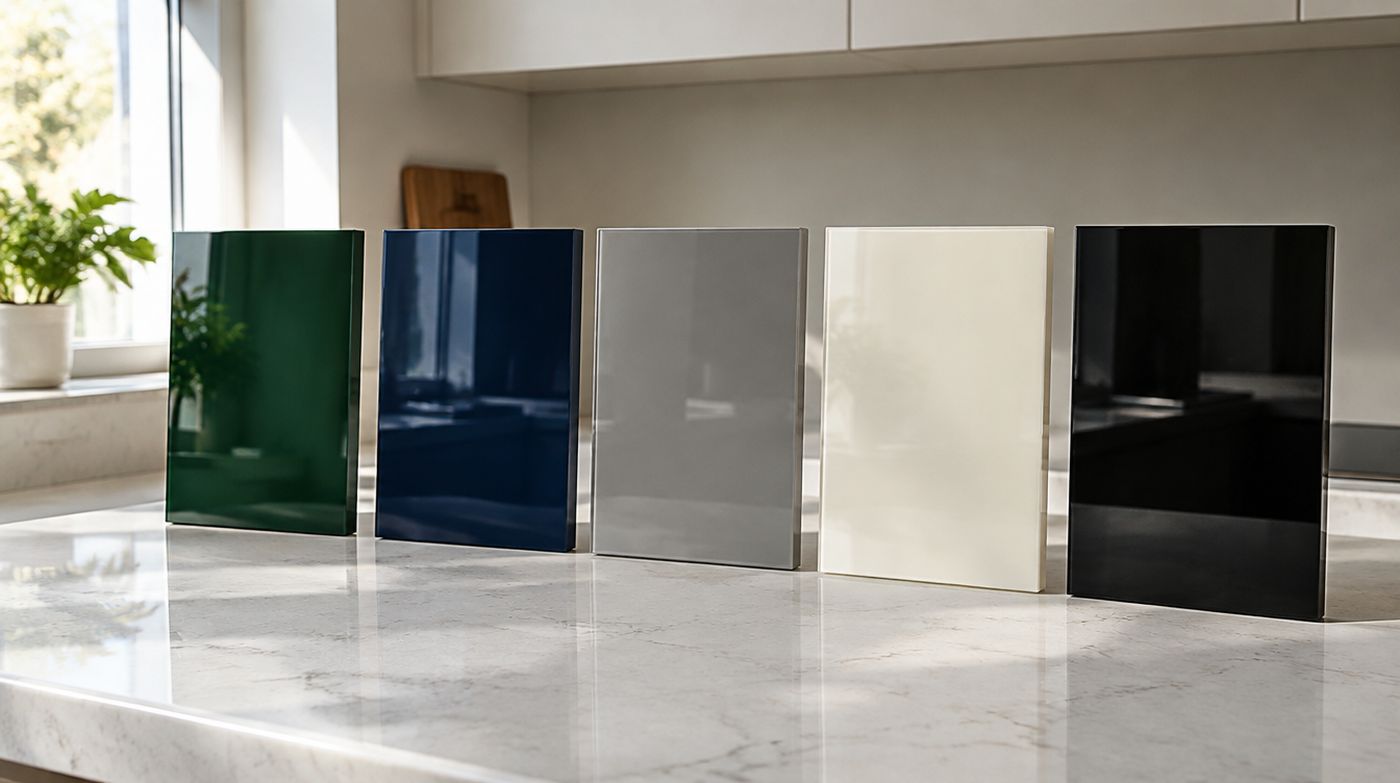
What makes a coloured glass splashback coloured
On almost every coloured glass splashback sold in London, the pane is ordinary clear float glass and the colour is a pigmented coating sprayed onto its rear face. You look at that colour through six millimetres of glass, which is why it reads deeper and wetter than the same shade rolled onto a wall. It also means the colour sits where nothing in a kitchen can reach it. No grout line, no surface film to wear through, nothing for grease to key into.
In our Wembley workshop the sequence is fixed. The glass is cut to the template, the socket and switch cut-outs are machined, the edges are worked and polished, the pane is washed, and then it is toughened. Only after toughening does it go into the spray booth and the curing oven. Paint applied before toughening would simply burn off in the furnace, and a toughened pane cannot be cut or drilled afterwards, so neither stage gets a second attempt.
Opacity matters more than most people expect. A deep charcoal covers a wall in a single pass. A soft white, a pale grey or a cream needs more material, and sometimes a white base coat under the colour, because otherwise any patchiness in the plaster behind will read faintly through the panel. That is why a pale splashback occasionally costs a little more than a dark one, which catches people out when they are expecting the opposite.
Printed images, patterns and graduated colour are a different process entirely, and we deal with those on the printed glass splashbacks page. Everything below is about flat, solid, back-painted colour.
Why the colour on a sample will not be the colour on your wall
Clear float glass carries a faint green cast in its body. On a dark colour you will never find it. On a white, a pale grey, a duck egg or a stone, it shows as a slight dullness, strongest when you view the panel at an angle and along the edges of a long run. Low iron glass is made with less iron oxide and removes that cast almost completely, so pale colours come out clean and cold rather than slightly olive.
That is also the first place to stop spending money. Low iron glass costs noticeably more per square metre, and behind a navy, an ink blue, a bronze, an olive or a black it buys you nothing you can see. If a quotation specifies low iron under a dark colour, ask what it is for. If your colour is anywhere near white, it is money well spent and we will say so.
Lighting does far more damage to colour decisions than glass tint ever will. Under warm 2700K strip lights set beneath wall units, a cool grey turns beige. Under 4000K downlights the same panel goes cold and blue. Most of the kitchens we survey are in side return extensions and rear additions with one rooflight and little direct sun, so artificial light is what you will actually see the splashback under for half the year.
So test the sample properly. Tape it to the wall in the exact position at the exact height. Look at it at breakfast, at six in the evening with only the under-cabinet lights on, and once with every light in the room running. Look at it from the doorway as well, not just from eighteen inches away. A colour chosen on a worktop in daylight and judged from close range is the most common route to a splashback somebody quietly dislikes.
Gloss, satin and whether matt coloured glass is a good idea
Back-painted glass is glossy by default, because the front face is the natural polished surface of float glass. If you want something flatter, that front face has to be acid etched or lightly blasted, which makes it a different product with different behaviour rather than the same panel in another finish.
An etched face hides fingerprints, kills reflections and looks calm. It is also a texture rather than a polished plane, so oil that spits out of a pan sits in it instead of on it. Behind a working gas hob, gloss wipes clean in one pass and an etched surface needs more effort and the right cleaner. We would rather tell you that now than after the panel is bonded to your wall.
Satin earns its place away from the heat: a utility room, a run behind a sink, a bathroom, a bank of units with no cooking at all. Behind a hob we specify gloss as a matter of course, and we think any supplier pushing an etched finish into that position should explain why.
How different colour families behave once they are on the wall
Which colour suits your units and your worktop is argued out on our kitchen glass splashbacks page, so we will not repeat it here. This is the other half of the question: how coloured glass splashbacks themselves behave in daily use, which is the part nobody mentions in a showroom.
Off-whites, stones and warm greys are the quiet default. They bounce light into a dark London kitchen, which is usually the real reason people pick them, and they are the one family where low iron glass is worth the money. They also show water spotting and splashes more clearly than anything else on the list, so take them on knowing you will wipe them.
Deep colours do the opposite. Ink blue, forest, olive, oxblood and charcoal read almost black under artificial light, sit well against brass, oak and veined stone, and hide marks between cleans. The catch is reflection. A gloss panel in a deep colour becomes a mirror after dark and shows you the whole room, including whatever has been left on the island behind you.
Strong saturated accents work best in one place rather than along a whole run. A single panel behind the hob in a colour you genuinely love, with the rest of the run in something quiet, costs less than an entire run in a bespoke shade and usually looks more deliberate. It is also a great deal easier to live with in five years, and cheaper to change your mind about.
Metallics, bronzes and mirrored finishes are the ones we steer people away from behind a hob. They telegraph every undulation in the wall behind them, show smears from arm’s length, and their reflective backing is the layer most vulnerable to moisture if an edge is left open to water. In an alcove or a dining area they can be genuinely beautiful. Behind a pan of boiling pasta they are a maintenance job you did not ask for.
Matching coloured glass splashbacks to a reference, and the limits of matching
A RAL number, a BS 4800 code, a Dulux name or a Farrow & Ball reference is all the workshop needs. That part is routine production work and it is not where the difficulty lies.
Matching to a physical object is where expectations need managing. If the panel has to match a painted wall, a cabinet door or an existing tile, give the surveyor the actual item or a decent offcut rather than a photograph. Even then, an emulsion on porous plaster and a cured coating viewed through glass will never be identical, because one is matt and absorbs light while the other is polished and throws it back. What you should expect is a close, deliberate reading of the same colour, not a laboratory match.
Where the match genuinely has to be right, ask for a sprayed sample on the same glass you are buying, and sign it off before the order goes into production. We do that as standard on bespoke references, and any competent supplier will do the same without being pushed.
One practical point that saves arguments later. If your job has a long run, a return wall and a set of upstands, they should all be sprayed in the same batch. Pale greys in particular can shift very slightly between booth sessions. Ordering the upstands or the window reveal piece three weeks after the main panels, or from a different supplier because they were cheaper, is exactly how people end up with two colours that are almost the same.
Where not to spend money on coloured glass splashbacks
Three places, and we will lose a little work by listing them. The first is thickness. Six millimetres is the right specification for a splashback and ten millimetres buys weight, cost and nothing visible. The reasoning is set out on our toughened glass splashbacks page.
The second is a colour match surcharge expressed as a percentage of the job. Spraying to a named reference is ordinary work. A modest fixed charge on a small order is fair enough, because a booth has to be set up and cleaned down whether the panel is 0.5 or 5 square metres. A percentage uplift across a whole kitchen is a different thing and should be challenged.
If a quotation carries a colour matching charge, ask what the figure is and what it pays for. Spraying to a reference is normal production, not a speciality service.
The third is replacing a surface you already like. If your existing tiles are flat, sound and clean, clear or low iron glass bonded over them protects them and gives you a wipeable face behind the hob without a strip-out, a replaster and a full back-painted run. We will tell you at survey when that is the better buy, even though it is the smaller invoice.
Signing the colour off before anything is cut
Nothing goes into the booth until the colour is confirmed in writing on the order, with the reference, the finish and the glass type all stated. Samples go out before that point. On a bespoke reference we spray a sample on the same glass; on a stock colour we leave a sample with you and ask you to live with it for a few days before you commit.
Once a pane is toughened and sprayed, it is that colour permanently. It cannot be stripped and redone, and it cannot be trimmed down and used somewhere else. That is the honest reason we are tedious about colour approval, and it is worth being equally tedious with any supplier you use anywhere in London.
FAQ
Questions about coloured glass splashbacks
Does the colour on a glass splashback fade or scratch off?
It should not, because the colour is not on the surface you touch. A back-painted splashback is sprayed on its rear face and cured, so the glass itself protects the coating from cleaning, steam, splashes and abrasion. What can damage it is impact or scratching to the back of the panel before it is fitted, and water sitting against an unsealed edge for a long period, which is why the bottom joint against the worktop is sealed properly. Strong colours are stable under normal kitchen light. A panel in constant direct sunlight is a reasonable thing to ask your supplier about before you order.
Is low iron glass worth paying for on a white splashback?
For white and other pale colours, usually yes. Standard clear float glass has a faint green cast in the body of the glass, and over a pale coating that shows as a slight dullness, most obviously at the edges of a long run and when you look along the panel rather than straight at it. Low iron glass removes almost all of it, so whites and soft greys read clean. Behind a dark colour there is nothing to see and nothing to gain, so do not let it be added to a quote for a navy or a charcoal panel.
Can you get a matt or satin coloured glass splashback?
Yes. The front face is acid etched or lightly blasted so it reflects less light, and the colour is still sprayed on the back. It looks calm, hides fingerprints and avoids the mirror effect that a gloss panel gives you after dark. The trade-off is cleaning. An etched surface is a texture, so cooking oil settles into it rather than on it and needs more work and a suitable cleaner to shift. We fit satin happily in utility rooms, bathrooms and runs away from a hob, and recommend gloss directly behind one.
Get a price for your splashback
Send the rough size and the colour you have in mind. We will template on site across London and confirm the colour on glass before anything is made.