Glass splashback fitters in London: what to ask before you book one
A splashback is bonded to the wall once and cannot be trimmed, moved far or drilled afterwards. The fitting is where the job is won or lost, so these are the questions we would ask if we were buying.
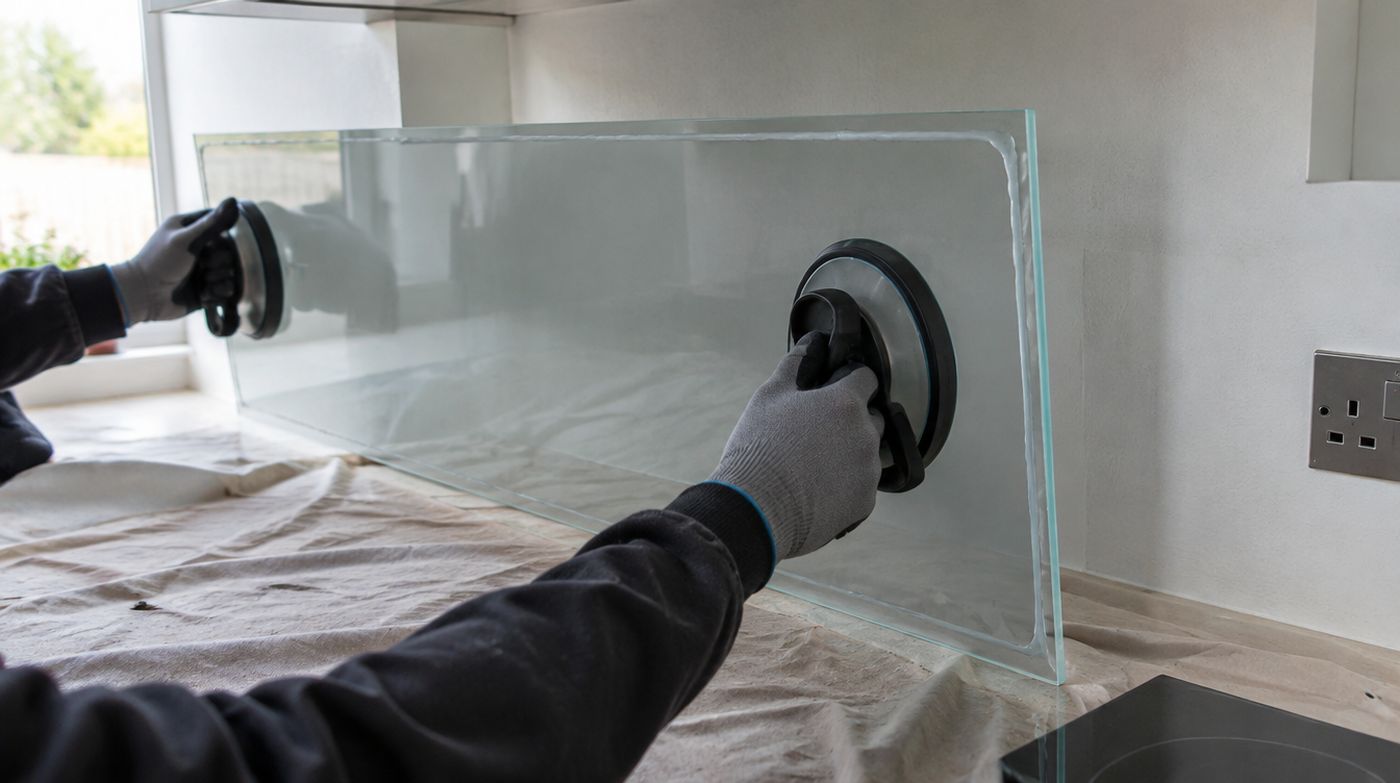
What separates glass splashback fitters in London from a general tiler
Good glass splashback fitters in London are judged on about forty minutes of work, and most of what matters happens before any adhesive leaves the tube. Bonding a panel is a single attempt. Once the glass touches the bed it is where it is, because sliding a rigid pane across silicone smears the bed, drags it into the cut-outs and destroys the contact you were relying on.
Nothing can be corrected afterwards either. Toughened glass cannot be trimmed, drilled or notched on site, so a cut-out five millimetres out of position is a remake rather than a tweak, and a panel three millimetres too long simply does not go in. There is no equivalent of cutting a tile on the day.
Then there is the physical side. Six millimetre glass weighs around fifteen kilos per square metre, so a three metre run is close to thirty kilos of awkward, slippery, unforgiving material that has to be carried through a finished kitchen, lifted over a worktop and placed accurately in one movement. Two people, clean hands, protected corners, and never resting a pane on a hard floor on one corner.
The structural question behind all of this is who carries the risk. If one firm templates the glass and an unconnected fitter installs it, nobody owns the outcome, and when a cut-out does not line up you will spend a fortnight listening to each of them blame the other. We template, make and fit, so there is only one party to hold responsible. Whoever you use, work out before you pay a deposit whose name is against the remake.
Adhesive: the biggest single difference between fitters
Ask a fitter which adhesive and sealant they use, by product name, and listen to how readily the answer comes. This is the most informative question you can ask and almost nobody asks it.
The right answer is a neutral cure silicone or an MS polymer, low modulus, applied in a pattern that supports the panel evenly and lets the bond cure. The wrong answer is a general purpose acetoxy silicone, which cures by releasing acetic acid and can attack the coating on the back of a painted panel or the backing of a mirrored one. That failure is slow and ugly: a bloom, a patch of discolouration, a shadow creeping in from the edges months after the kitchen was finished.
Solvent based grab adhesives are a mixed bag. Some are compatible with back-painted glass and some soften or stain it, and the only acceptable answer is a named product the glass supplier approves for the coating on your panel. A tube of whatever happened to be in the van is exactly what this question is designed to detect.
Two details that separate a careful job from a quick one. The bond needs thickness, so the panel sits on a bed rather than being squashed flat to the plaster, which is what lets it tolerate a little movement. And on a pale back-painted panel the pattern of adhesive can read through the glass as faint patches if it is applied as random blobs, which is one of the reasons the bed pattern is a specification and not an improvisation.
Cure time comes with it. Expect to be told how long before the supports and tape come off, how long before you cook, and how long before the panel is cleaned. A fitter who leaves without telling you any of that has left you to guess.
Wall preparation, and who is actually supposed to do it
A sheet of glass is perfectly flat and a London plaster wall is not. Hold a straight edge across the wall and you learn in seconds whether a panel will sit evenly or bridge a hollow and rock on a high spot. Where the wall is out by more than the bond line can absorb, the wall gets made good. Packing the glass out with lumps of adhesive to chase a bad wall is the visible, avoidable failure.
Substrates to be careful with: dot and dab plasterboard, which drums and flexes and is only supported where the dabs are; fresh skim that has not dried; dusty or friable plaster, which needs a sealer; and emulsion that comes away when you scrape it with a thumbnail. If the paint lets go, the glass comes off the wall with the adhesive still perfectly attached to it.
Tiles are a yes or a no, not a maybe. Sound, flat and firmly bonded tiles can be glassed over, and that saves a strip-out and a replaster. Hollow or cracked ones come off first. Either way the build-out at the panel edges is a decision to take at drawing stage rather than a surprise on the day.
Here is the commercial point, and it is where quotes catch people out. Most splashback quotations assume a flat, dry, prepared wall. If yours is not, somebody has to pay to make it so, and that cost usually appears on fitting day when your kitchen is finished and you have no leverage. Ask the question before you pay a deposit: what happens if the wall fails the straight edge, who does the making good, and what does it cost.
What a good fitting day looks like
The panel arrives protected and is checked against the approved drawing before it comes anywhere near the wall. Worktop and floor get covered. Then the single most important step in the whole installation: the panel is offered up dry, with no adhesive, and every cut-out is checked against the actual socket boxes and the tap tails on your wall. That dry fit is what separates fitters who finish the job from fitters who start one.
Electrics come next and they tell you a lot. The circuits should be isolated at the consumer unit before any faceplate is removed. A fitter who pulls a live plate off with a screwdriver and no tester is showing you how the rest of their standards work.
Adhesive is then applied in the correct pattern, the panel is set on spacers so it does not sit in the bottom bead and slide, pressed home evenly from the centre outwards, and supported or taped while it grabs. Faceplates go back on, and the joints are pointed in a sealant colour you chose in advance rather than whatever matches the van. Joints and silicone colour are covered on our kitchen splashbacks page.
At the end, the old tiles and glass offcuts leave with the fitter, the protective film comes off, and you get a straight answer on cure times. Half an hour of tidy work at the end of a fitting is a reasonable thing to expect and a fair thing to judge.
Warning signs in a quote or on a London doorstep
None of the following is proof of a bad firm on its own. Two or three together, and we would walk away.
- A price given from a kitchen drawing or a tape measurement, with no survey or template.
- A refusal, or an inability, to name the adhesive and sealant products.
- No written specification of glass type, thickness and the toughening standard.
- The phrase we can trim it on site if it is tight. Toughened glass cannot be trimmed.
- No question about your hob make and model, or about the manufacturer’s clearance.
- A demand for most of the job value as a deposit before a drawing has been produced.
- No registration, no public liability cover offered and no paperwork with the order.
- A fitter you have never been introduced to, from a firm you did not buy from.
One more that is harder to spot. If the person quoting cannot tell you where the glass is processed, they are reselling panels from an unnamed source and they cannot answer a question about conformity, lead time or a remake without making a phone call. We cut, process and toughen in our own Wembley workshop, which is the only reason we can give firm answers on all three.
What to pay for, and what to refuse to pay for
A survey and template charge is legitimate. Someone spends an hour or more in your house and produces a drawing. What you should expect is that the figure is stated up front and credited against the order if you go ahead. An undisclosed survey fee, or one that is not credited, is a hook rather than a cost.
Tile removal is work you can do yourself if you are handy with a bolster and willing to fill a few rubble bags, and on a small area that can save a chunk of labour. Be realistic though: if the plaster comes off with the tiles, you need a plasterer, and a plasterer charges less per square metre to fix a wall than a glazing firm does to make good around a panel.
Two specifications not to pay for behind a hob: ten millimetre glass and heat soaked glass. Neither improves a bonded splashback, and both appear on quotations as premium options. The reasoning is on our toughened glass splashbacks page.
Lastly, be sceptical of a premium for same day or next day fitting on a bespoke panel, which some glass splashback fitters in London will offer when a diary is empty. Nothing about a made to measure splashback is same day. A firm promising it is either fitting a stock size, cutting corners on cure times, or guessing at measurements it has not taken.
What to inspect before you sign the job off
Stand square to the panel and check the reveal: the gap at each end and along the bottom should be even, and the panel should sit plumb rather than following a leaning wall. Look along the glass at a shallow angle from one end. Minor ripple in toughened glass is normal, but a panel that visibly undulates is sitting on a wall that should have been made good.
Then look at the colour in flat daylight, especially on pale panels, for faint patches or shadows that track the adhesive pattern. Check that socket cut-outs sit concentric behind their faceplates with no sliver of wall showing, that the bottom joint is a continuous tooled bead rather than a wiped smear, and that no silicone has been pressed out onto the face and polished over.
Run a fingertip along the exposed edges for chips, which are both a cosmetic issue and the place a toughened pane will eventually fail from. Finally, ask for the paperwork: the specification of the glass, the standard it was toughened to, the products used to bond and seal it, and the cure times in writing. Any fitter who objects to being asked for that has told you everything you needed to know about who to call next time.
FAQ
Questions about glass splashback fitters london
How do I know if a glass splashback fitter is any good?
Judge them on three things before they start. First, do they template rather than take tape measurements, and will they put glass type, thickness and the toughening standard in writing. Second, can they name the adhesive and sealant they use, and explain why a neutral cure product matters behind painted glass. Third, who carries the cost of a remake if a cut-out is wrong. On the day, the test is whether the panel is offered up dry and every cut-out checked against the real socket boxes before any adhesive is applied. A fitter who skips that step is gambling with your panel.
Can I fit a glass splashback myself?
A small panel over a flat, sound surface is realistic for a competent DIYer, provided you use a neutral cure silicone that your glass supplier approves, set the panel on spacers, and accept that you get one attempt at placing it. A full run is a different matter. Three metres of six millimetre glass is around thirty kilos, it has to be lifted over a finished worktop and placed accurately in one movement, and cut-outs have to line up with socket boxes with no adjustment available. Most of the damage we are asked to look at happened in the last ten seconds of a solo installation.
Who is responsible if a glass splashback cracks after it has been fitted?
It depends on the cause, and a competent supplier will tell you honestly which it was. A fracture starting from a chipped edge or an unradiused internal corner on a cut-out points at processing or handling, which is the supplier's responsibility. A crack at a point of impact is accidental damage. A thermal fracture behind a hob fitted with less clearance than the appliance manufacturer requires points at the installation or the specification. This is why the hob model, the clearance and the glass standard belong on the paperwork from the start, and why buying glass and fitting from two unconnected firms leaves you in the middle.
Get a price for your splashback
Send the rough size and the colour you have in mind. We will template on site across London and confirm the colour on glass before anything is made.