Bathroom glass splashbacks, and how they differ from a kitchen job
A bathroom panel sees no heat and a great deal of water, sits at eye level, and usually has brassware coming through it. Every one of those things changes the specification.
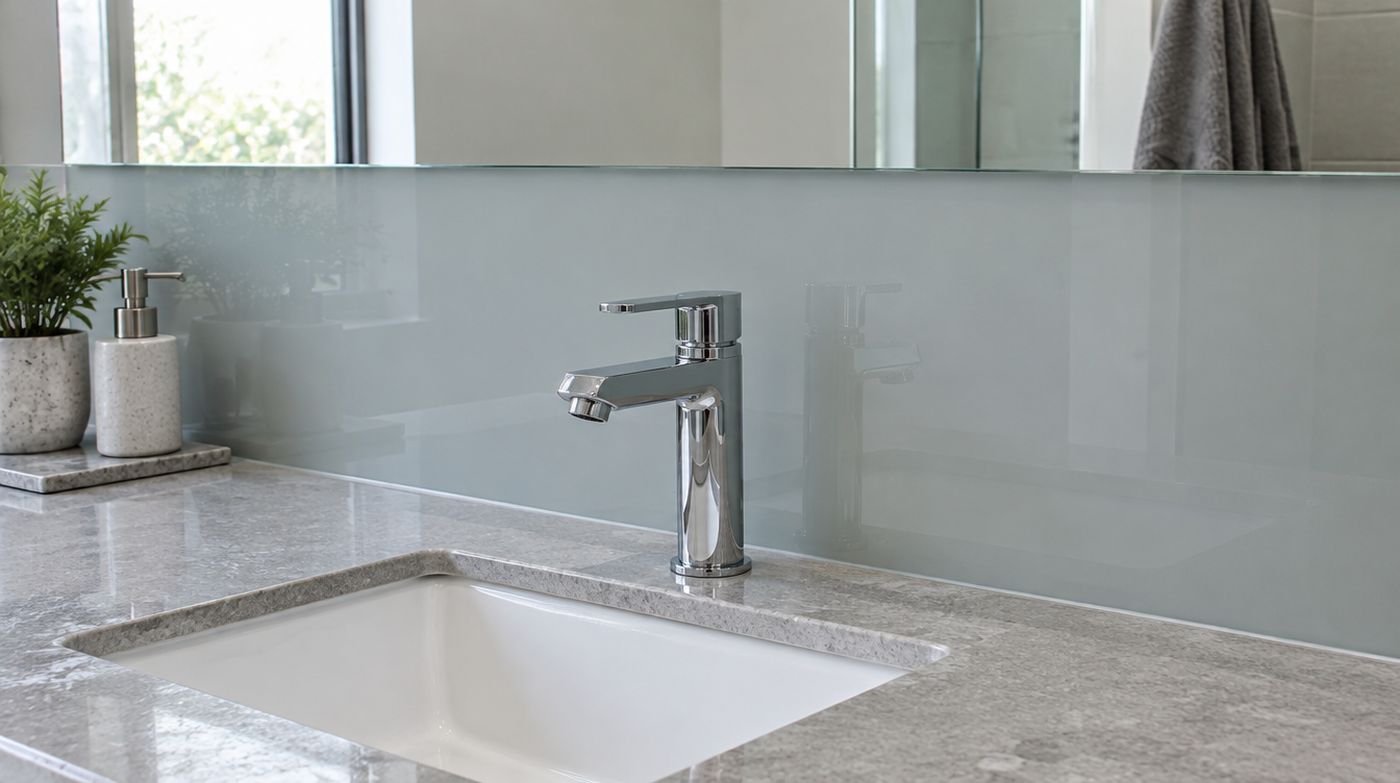
What changes when a splashback goes in a bathroom instead of a kitchen
Bathroom glass splashbacks are often treated as a smaller version of a kitchen job, and they are not. The thermal argument disappears, because nothing in a bathroom heats glass unevenly, so toughening here is about safety and handling rather than thermal stress. The water argument replaces it, and water is more patient than heat. It finds an unsealed edge and works at it for years.
Scrutiny changes too. A kitchen splashback is seen from across the room with a kettle and a chopping board in front of it. A bathroom panel behind a basin is seen from twelve inches away, every morning, in good light, while you are standing still. Flatness, the evenness of the silicone line and the exact tone of the colour all get examined in a way they never are in a kitchen.
Then there is movement. A bathroom goes from cold to full steam and back twice a day, and everything in it expands and contracts slightly with that cycle. The bond and the sealant have to accommodate it, which is why neutral cure products are used and why a rigid bed of the wrong adhesive is a worse idea here than almost anywhere else.
The reason people do it anyway is simple and good. A run of grout behind a basin discolours, whatever you scrub it with, because grout is porous and toothpaste, soap and water live in it. One pane of glass with a single sealed joint at the bottom has nothing to discolour.
Behind a basin, behind a bath, inside a shower: where glass works
Behind a basin is the obvious one and the most common. A panel runs from the back of the basin up to the underside of a mirror or a cabinet, or to a height you choose, with cut-outs where wall-mounted taps come through. Where the brassware is awkward it is sometimes better to split the panel either side of the tap than to put a large cut-out in the middle of a small pane.
Above a bath, a single panel replaces three or four rows of tile and the grout that goes with them. One detail that matters: the bath should be filled with water when the bottom joint is sealed, so the bath sits at its loaded position and the silicone is not stretched the first time somebody gets in. An acrylic bath can drop several millimetres under a full load and a bather.
A shower is where we start saying no, or at least saying it properly. A large pane can line a shower wall and it looks superb, but it is a different job from a splashback: thicker glass, careful seam and corner detailing, and a substrate behind it that has been tanked and is genuinely sound. Glass bonded over a failing or untanked wall does not waterproof it, it hides it. If someone offers to solve a leaking shower with a splashback, that is the moment to get a different trade in.
Cloakrooms and utility rooms are the easy wins. Small panels, awkward spaces, a wall behind a washing machine that nobody wants to tile, and the place where stock sizes and offcuts make real financial sense.
Water, sealant and the edge that fails first
Back-painted glass is sealed at its face by the glass itself. The vulnerable part is the edges, where water can reach the coating if it is given a route and time. So the bottom joint, against a basin, a worktop or a bath rim, needs a continuous bead of sanitary silicone with a fungicide in it, tooled into a proper concave profile rather than smeared with a finger.
The top edge is usually left open. That surprises people, but a panel sealed on all four sides traps any moisture that does get behind, whereas an open top edge lets the void breathe and dry. Where a panel meets a mirror, a cill or a cabinet above it and an open joint would look unfinished, we seal it and make sure the bond and the substrate below are right.
Sealant chemistry is not a detail you can ignore in a bathroom. General purpose silicone that cures by releasing acetic acid can attack the back coating of a painted panel, and it is lethal to the reflective backing of a mirrored one. Neutral cure silicone or an MS polymer only. The adhesive argument in full is on our glass splashback fitters page, and it is worth reading before you let anyone bond a panel in your bathroom.
One more thing about the bead itself. A joint squeezed into a gap of a millimetre or two cannot be cleaned and will not last. Leave the panel a sensible gap at the bottom, fill it properly, and you have a joint you can wipe rather than a line of mould you can only pick at.
Fixing glass to a bathroom wall: tiles, plaster and board
Over existing tiles is often the best value option in a bathroom, provided the tiles are sound, reasonably flat and firmly stuck. Tapping across them finds the hollow ones, and any that are loose come off before anything is bonded. The consequence to think about is build-out: the panel will stand proud of the surrounding surface by the tile depth plus the bond line, so where it meets a window reveal, a door architrave or a bath panel, that step has to be planned rather than discovered.
Plaster has to be dry, sound, dust free and sealed. New plaster needs to be properly dry before it is sealed and bonded to, and in a bathroom that takes longer than people think. Flaking emulsion or a dusty skim will let go while the adhesive remains perfectly stuck to the back of your glass, which is a repair nobody enjoys.
Moisture resistant plasterboard and tile backer board are both fine substrates when they are fixed properly to a solid framework. Dot and dab board is the problem child: it drums, it flexes, and the support is only where the dabs are. For a rigid pane that matters, and in a bathroom where the board is also dealing with humidity it matters more.
Where a substrate cannot be trusted and cannot be made good, the answer is mechanical fixing. Holes are drilled before toughening and the panel is fixed with stainless caps, usually at the corners. It is a visible solution and some people dislike the look, but it is honest engineering and in a few bathrooms it is the right call. What it is not is a decision that can be made on the day, because a toughened panel cannot be drilled once it is made.
Sizes, cut-outs and the awkward bathroom details
Bathroom panels are smaller than kitchen ones and frequently more complicated. Wall-mounted basin taps and bath fillers need cut-outs sized so the escutcheon or flange covers the edge. Concealed cistern frames need their access panel left accessible, and yes, we have been asked to bond glass straight over one. Shaver sockets, pull cords, extractor grilles and towel rail brackets all have to be set out on the drawing, not negotiated on site.
Window reveals in a London bathroom are rarely square, and a glass return into a reveal is one of the places where templating earns its money. The same goes for a panel that has to stop short of a door opening, or run past a boxed-in soil pipe that is 8mm out of plumb over its height.
Sheen and colour deserve a thought because of mirrors. A coloured panel sitting directly under or beside a mirror is compared against it constantly. Either match the reflectivity deliberately or contrast it deliberately. The outcome to avoid is an accidental half match, where a gloss panel in a warm grey sits next to a mirror and simply looks like a mirror that has gone wrong.
Upstands are worth mentioning too. A slim glass upstand along a vanity top, colour matched to the main panel, deals with the junction between a worktop and a wall far better than a bead of silicone on its own, and uses very little glass.
Where not to spend money on bathroom glass splashbacks
Start with how much glass you actually need. Wrapping a bathroom in glass from skirting to ceiling is a large sum of money for a surface you look at rather than use. A panel behind the basin and a run above the bath does the work that grout was failing at, and leaves the rest of the room as it is. If your existing tiles are sound and you like them, that is the cheaper and better answer.
Low iron glass follows the same rule here as in a kitchen. Worth it under a white or a pale grey, pointless under a dark colour, and we have set out why on our coloured glass splashbacks page. Do not let it ride along on a quote for a navy panel.
We would also talk you out of mirrored and antique mirrored panels inside a shower or directly over a bath. The reflective backing is the layer water attacks, and a steamy wet area is where it gets the most opportunity. In a dry part of the room, by all means.
Finally, a small square panel behind a basin in a straight, square opening does not need a bespoke template. A stock size with a properly tooled joint at each end is quicker and cheaper, and the finished job is identical. The templating argument applies to runs, returns and reveals, and we explain where the line sits on our made to measure page.
FAQ
Questions about bathroom glass splashbacks
Can you fit a glass splashback in a shower?
A pane can line a shower wall, but treat it as a different product rather than a splashback. It needs thicker glass, deliberate detailing at the corners, the floor junction and any seams, and above all a substrate that has already been tanked and is sound. Glass bonded over a wall that is letting water through does not stop the leak, it conceals it and gives the water somewhere to collect. For a bathroom we are much happier putting glass behind a basin, above a bath or in a utility area and leaving a wet shower enclosure to a tanked tiled or large format system.
Do bathroom glass splashbacks need sealing along the top edge?
Usually not, and leaving it open is deliberate rather than lazy. Sealing all four edges traps any moisture that works its way behind the panel, while an open top edge lets the void breathe and dry out between showers. The joint that has to be continuous and properly tooled is the bottom one, against the basin, worktop or bath rim, in a sanitary silicone containing a fungicide. Where a panel runs up to a mirror, a cabinet or a window cill and an open joint would look unfinished, we do seal it. In that case the substrate behind it and the bond pattern matter more, because the panel has no easy route to dry.
Do bathroom splashbacks need to be toughened glass?
There is no thermal reason in a bathroom, but we still specify thermally toughened glass to BS EN 12150 and so should anyone else. A splashback is a large rigid pane at hip or chest height in a hard room, and a bathroom is where people slip, drop things and lean on surfaces. Toughened glass breaks into small blunt fragments rather than long shards. It also survives being carried up a London staircase and offered up to a wall, which annealed glass of the same size often does not. The technical detail is on our toughened glass splashbacks page.
Get a price for your splashback
Send the rough size and the colour you have in mind. We will template on site across London and confirm the colour on glass before anything is made.